AI Prompt
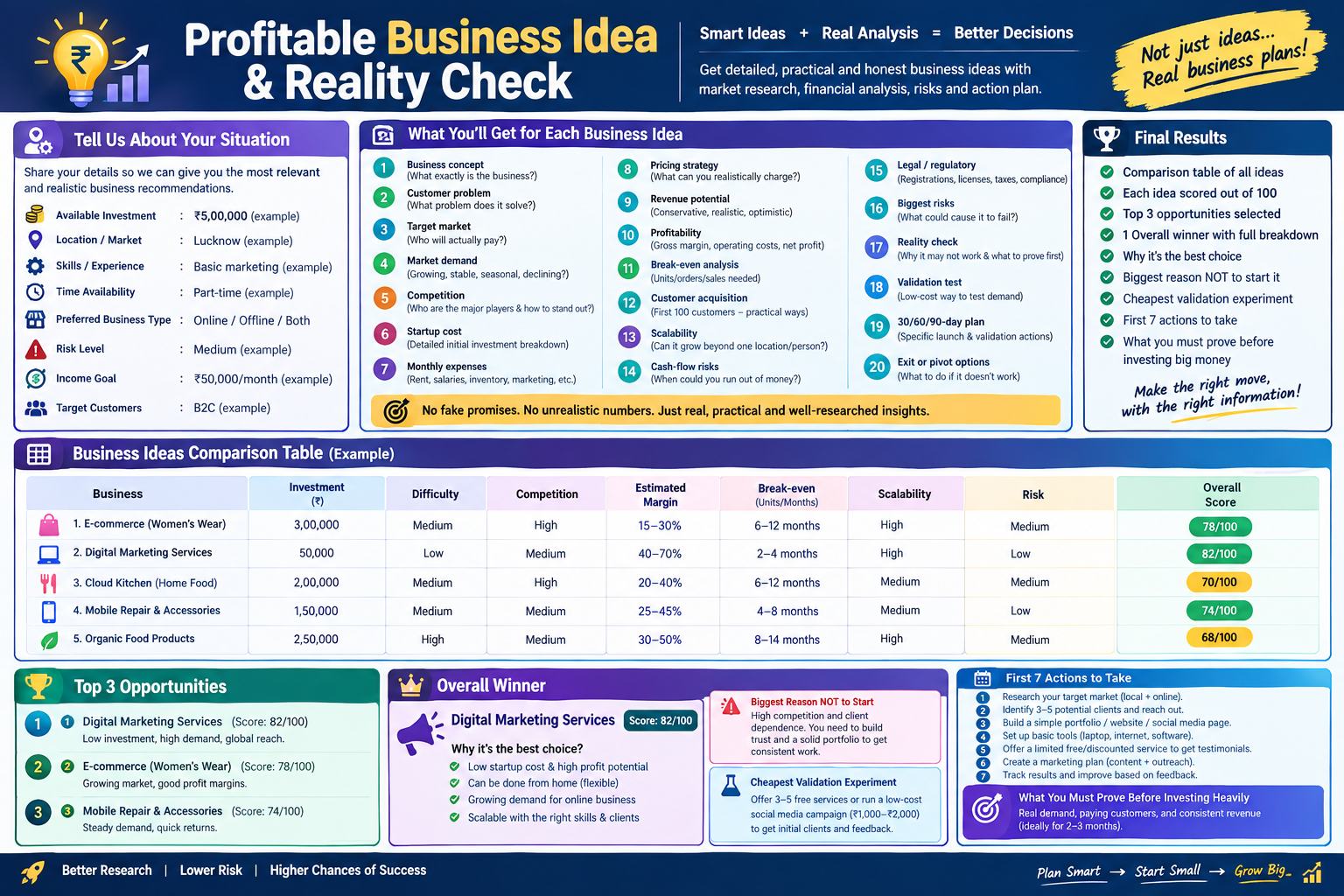
Profitable business ideas
Act as a startup strategist, business consultant, market researcher, and skeptical investor. I want you to identify and evaluate profitable business
Act as a startup strategist, business consultant, market researcher, and skeptical investor.
I want you to identify and evaluate profitable business opportunities based on my situation. Do not simply give me ideas that sound exciting—focus on businesses that have realistic potential to make money and survive in the real market.
My details:
- Available investment: [Enter budget]
- Location/market: [City/Country]
- Skills or experience: [Enter skills]
- Available time: [Full-time/Part-time]
- Preferred business type: [Online/Offline/Manufacturing/Service/E-commerce/Any]
- Risk level: [Low/Medium/High]
- Income goal: [Monthly/Yearly target]
- Target customers: [B2B/B2C/Both]
For each business idea, analyze:
1. Business concept — What exactly is the business?
2. Customer problem — What problem does it solve?
3. Target market — Who will actually pay for it?
4. Market demand — Is the demand growing, stable, seasonal, or declining?
5. Competition — Who are the major competitors and what can I do differently?
6. Startup cost — Give a realistic estimated breakdown of initial investment.
7. Monthly expenses — Include rent, salaries, inventory, marketing, technology, utilities, logistics, etc.
8. Pricing strategy — What could I realistically charge?
9. Revenue potential — Give conservative, realistic, and optimistic scenarios.
10. Profitability — Estimate gross margin, operating costs, and possible net profit.
11. Break-even analysis — Estimate how many customers/orders/sales are needed to break even.
12. Customer acquisition — Explain practical ways to get the first 100 customers.
13. Scalability — Can this business grow beyond one location or one person?
14. Cash-flow risks — Identify situations where the business could run out of money.
15. Legal/regulatory considerations — Mention important registrations, licenses, taxes, or compliance requirements where relevant.
16. Biggest risks — Be brutally honest about what could cause the business to fail.
17. Reality check — Explain why this idea may NOT work and what assumptions must be proven first.
18. Validation test — Give me a low-cost way to test demand before investing heavily.
19. 30/60/90-day plan — Give specific actions for launching and validating the business.
20. Exit or pivot options — Explain what I could do if the original model doesn't work.
IMPORTANT RULES:
- Do not promise guaranteed profits.
- Do not use unrealistic revenue projections.
- Separate assumptions from facts.
- Point out hidden costs and overlooked risks.
- If the idea is oversaturated, say so clearly.
- If the business is not financially attractive, reject it rather than forcing a positive answer.
- Prefer sustainable businesses over temporary trends.
- Consider local purchasing power and customer behavior.
- Explain where the numbers are estimates and how I can verify them.
- If current market information is required, use reliable and recent sources.
After analyzing the opportunities, create a comparison table containing:
Business | Investment | Difficulty | Competition | Estimated Margin | Break-even | Scalability | Risk | Overall Score
Score every idea out of 100 based on:
- Demand: 20
- Profit potential: 20
- Competition: 10
- Startup affordability: 15
- Scalability: 15
- Customer acquisition: 10
- Risk: 10
Finally:
- Select the TOP 3 opportunities.
- Pick ONE overall winner.
- Explain why it is the best choice.
- Give the biggest reason NOT to start it.
- Give the cheapest validation experiment.
- Give the first 7 actions I should take.
- Tell me exactly what I should prove before investing significant money.
Your goal is not to make me excited about a business idea. Your goal is to help me make a financially sensible decision.
Published: 2026-09-15